
Choose a posture
Start with Essential, AI-First, Fortress, or Custom instead of assembling rules from memory.
WordPress crawl governance
Build robots.txt, separate crawler families, publish optional llms.txt and AI usage signals, then review everything before it goes live. No raw-file editing required.
Public governance
Canonical references
# Search discovery
User-agent: OAI-SearchBot
Allow: /
# Model training
User-agent: GPTBot
Disallow: /
Sitemap: https://example.com/sitemap.xmlOne guided workflow
Better Robots.txt turns crawler governance into a clear operational sequence instead of a fragile text-editing exercise.
Start with Essential, AI-First, Fortress, or Custom instead of assembling rules from memory.
Keep search, training, answer engines, user-triggered agents, archives, SEO tools, and bad bots distinct.
Add optional llms.txt and AI usage signals without confusing guidance with technical enforcement.
Preview the generated policy, understand the winning rules, and keep every decision reversible.
See the product, not a promise
The interface moves from preset selection to crawler-level controls and a final publishable preview. The plugin remains one layer in a broader SEO and AI visibility strategy.
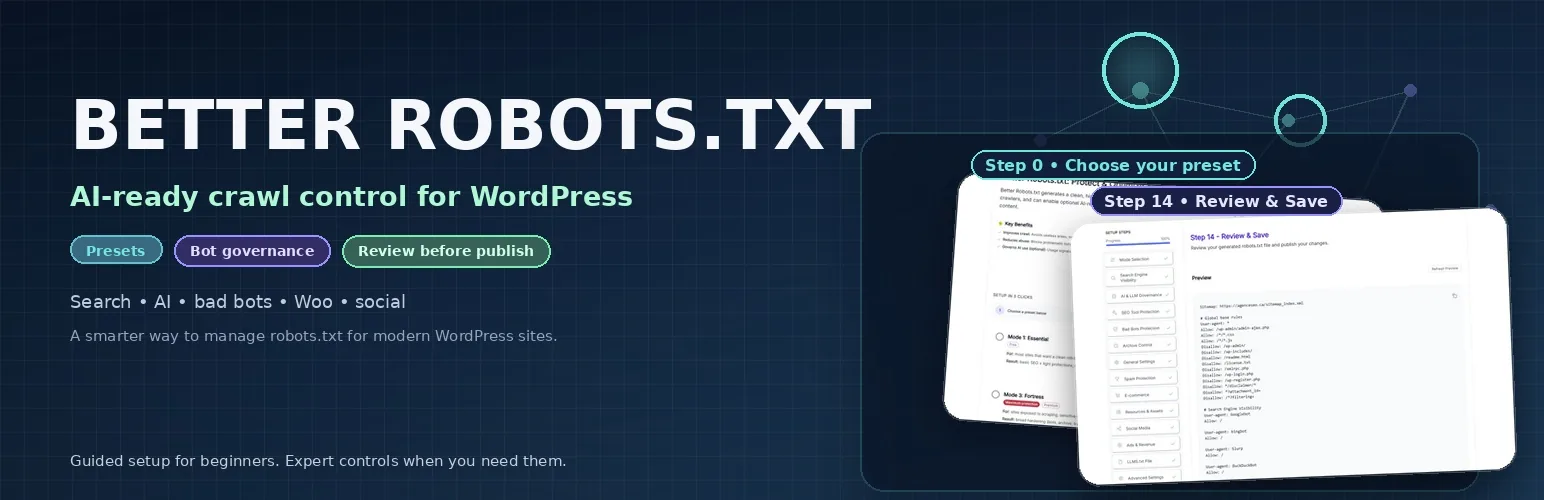 Watch the guided workflow
Audit before you configure
Scan robots.txt, llms.txt, AI crawler coverage, machine-readable signals, WordPress hygiene, and public resource access in about 30 seconds.
Four operating models
The presets are starting positions, not opaque promises. Every choice remains reviewable and adjustable.
Clean robots.txt foundations and safer defaults for most WordPress sites.
Explore the presetA clearer AI usage posture while keeping useful search and answer-engine discovery open.
Explore the presetProtection-oriented defaults for scraping, archive, training, and higher-risk contexts.
Explore the presetModule-by-module control for teams that already know the exact policy they need.
Explore the presetUse the site as a decision system
The detailed documentation remains available without forcing every visitor through a wall of interchangeable cards.
Machine-readable by design
Better Robots.txt distinguishes crawl directives, post-crawl usage preferences, interpretive guidance, and infrastructure enforcement. It does not claim that publishing a file guarantees crawler obedience, ranking, retrieval, or citation.
Start with evidence